 HUNTING CHARACTERISTICS: Douc langur diets are dominated by tree
leaves, petoles and buds with secondary use of fruits and seeds.
HUNTING CHARACTERISTICS: Douc langur diets are dominated by tree
leaves, petoles and buds with secondary use of fruits and seeds.
DOUC LANGUR
 NAME: Douc langurs (Pygathrix nemaeus) are colobine monkeys.
HABITAT: Douc langurs are found most frequently in primary evergreen forests of Vietnam and Laos. Once thought to be rare with limited distributions, recent fieldwork has demonstrated that douc langur populations are quite widespread and found in a variety of habitats and that they display ecological and social flexibility.
The red shanked douc langur (Pygathrix nemaeus nemaeus) has been located in north, central and southern provinces of Vietnam. The black shanked douc langur (Pygathrix nemaeus nigripes) distribution appears to be confined to various provinces of southern Vietnam.
While douc langur monkeys are restricted to wooded habitats, they occur in a variety of forest types. Populations of doucs have been located from both monsoon forests as well as rainforests and include: semi-evergreen, lowland lower montane and upper montane forest types.
HUNTING CHARACTERISTICS: Douc langur diets are dominated by tree
leaves, petoles and buds with secondary use of fruits and seeds.
PHYSICAL CHARACTERISTICS: The place of the douc langur in the general phylogeny of the Asian colobines has been the subject of an ongoing debate. The standard description of the red shanked douc langur is as follows. The legs are maroon from the knees to the ankle with the thighs, fingers and toes black. The body is gray with agouti hairs of black, white & gray. The arms are white from the elbows to the wrists & the upper arms are gray like the body.
A prominent white triangular rump patch surrounds the long (589- 770 millimeter) tail of the same color. Adult and juvenile males can be distinguished from females by the circular white spot found on either side and superior to the corners of the rump patch. This dimorphic characteristic is found in both the red and black shanked douc langur. Both sexes of each species exhibit a white perineum.
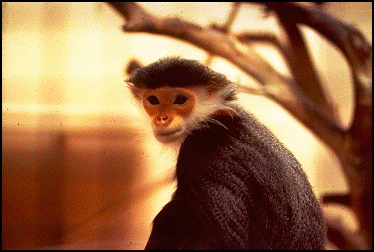
The white hairs on the cheeks of the red shanked douc are long (in comparison to the black shanked douc) and red predominates over black in the two colored frontal band over the eyes. The face around the eyes is reddish yellow. In the black shanked douc, the cheek hairs are characteristically short and black predominates over red on the two color frontal band. The region around the eyes is black, imparting a black coloring to the entire face.
In the black shanked douc langur, the hindlimbs are entirely black and the forelimbs (except for the fingers) and the body are gray (agouti hairs) with the chest being a lighter gray than the rest of the body.