TIGER
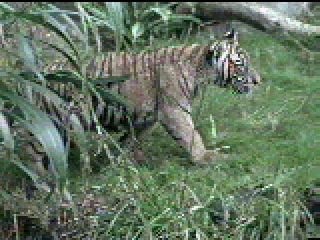 NAME: The tiger is the largest member of the cat family. It lives in Asia and belongs to
the same genus as the lion, leopard, and jaguar. Two major subspecies are the Siberian tiger and
the Bengal Tiger. The modern tiger is thought to have originated in northern Asia during the
Pleistocene Epoch and spread southward thereafter, crossing the Himalayas only about 10,000 years
ago. Tigers belong to the family Felidae. The Siberian tiger is classified as Panthera
tigris altaica, and the Bengal tiger as Panthera tigris tigris.
NAME: The tiger is the largest member of the cat family. It lives in Asia and belongs to
the same genus as the lion, leopard, and jaguar. Two major subspecies are the Siberian tiger and
the Bengal Tiger. The modern tiger is thought to have originated in northern Asia during the
Pleistocene Epoch and spread southward thereafter, crossing the Himalayas only about 10,000 years
ago. Tigers belong to the family Felidae. The Siberian tiger is classified as Panthera
tigris altaica, and the Bengal tiger as Panthera tigris tigris.
PHYSICAL DESCRIPTION AND HABITAT: The very rare Siberian tiger measures 1.4 to 2.8 meters
(4.6 to 9.2 feet) long, not including the tail, which is 69 to 95 centimeters (27 to 37
inches) in length, and weighs 180 to 305 kilograms (400 to 675 pounds). It has thick
yellow fur with dark stripes. The Bengal tiger, which
is about 3 meters (about 10 feet) long, including the tail, and usually weighs 180 to 258
kilograms (400 to 569 pounds), is found on the mainland of southeastern Asia and in central and
southern India. Its coat lies flatter than that of the Siberian tiger, the
tawny color is richer, and the stripes are darker. The
tiger on the island of Sumatra is even smaller and darker.
HUNTING CHARACTERISTICS: The diet is varied, ranging from deer and cattle to frogs & fish;
carrion is also eaten.
SPECIAL ADAPTATIONS: The Bengal tiger inhabits grassy or swampy areas and forests, where
it is well camouflaged by its coloration. Those living on islands have almost disappeared.
 INTERESTING FACTS: The tiger is a solitary animal, males and females coming together
only at mating time, to share a kill, or to drink and rest at watering holes in areas with
limited water. The litter numbers one to six cubs, which stay with the mother into their second
year.
INTERESTING FACTS: The tiger is a solitary animal, males and females coming together
only at mating time, to share a kill, or to drink and rest at watering holes in areas with
limited water. The litter numbers one to six cubs, which stay with the mother into their second
year.
Tigers have been hunted to near extinction by poachers in many Asian countries. Tiger body parts
are sought for use in traditional Chinese medicine and exotic recipes. All subspecies of the
tiger have been declared endangered.